Handguns
e.g. .357 Magnum, .44 Magnum
- VPAM
- VR3 · VR4
- Comparable*
- BR3 / BR4 · FB3 / FB4
- TRASCO
- A-KIP® level 4 (lightweight, protected areas only, no VR class)

Language

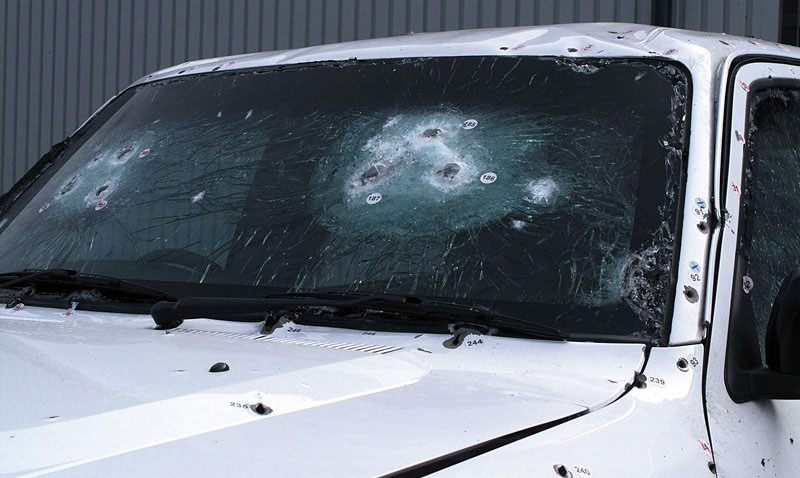
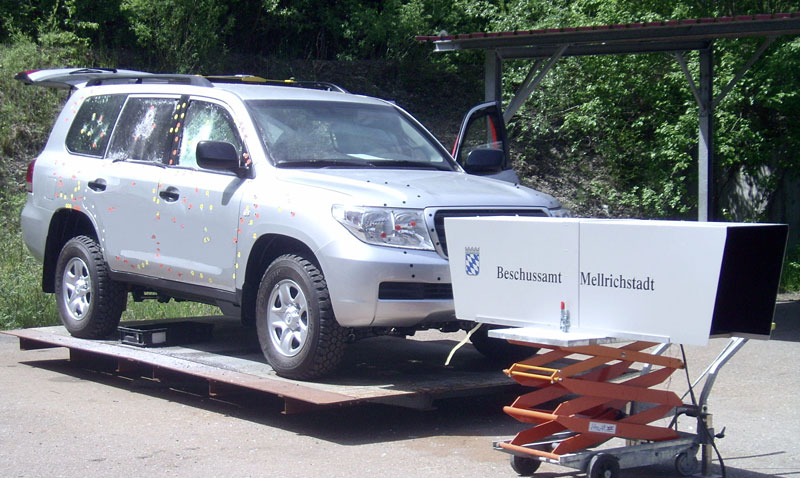
A protection level is not a marketing word – it is a defined weapon, bullet, velocity and hit pattern. Here is how to read one.
How to read a level
VPAM levels are defined by the exact threat they defeat: the weapon and caliber, the bullet construction, its velocity at impact – and the hit pattern: three shots on the vertices of a triangle of only 120 ±10 mm. Tested on the complete vehicle, the test institute deliberately targets the weakest points: joints, pillars, locks and glass edges.
How to read a TRASCO protection code
B6 - DM51 - 15kg@3m
At a glance
Start from the threat, not from the norm: which levels protect against which weapons, how they compare to other standards and which TRASCO program covers them.
e.g. .357 Magnum, .44 Magnum
e.g. AK-47, 5.56×45 mm, 7.62×51 mm
e.g. 7.62×39 BZ-API, 7.62×51 AP
Direct fire
Test conditions meet or exceed the European Committee for Standardization standards (EN 1063, 1522, 1523) for qualification and certification of armor solutions. On customer request, STANAG 4569 test conditions can also be used.
| VPAM | Comparable* | Weapon / caliber | Bullet | Mass | Velocity | Energy |
|---|---|---|---|---|---|---|
| 4 | BR3 / FB3 / VR3 | .357 Magnum (Geco) | FMJ/CB/SC | 10.20 g | 430 ±10 m/s | 943 J |
| 4 | BR4 / FB4 / VR4 | .44 Rem. Magnum (Speer) | FMJ/FN/SC | 15.60 g | 440 ±10 m/s | 1,510 J |
| 6 | – | AK-47 · 7.62×39 (M43) | FMJ/PB/FeC | 8.00 g (core 3.60 g) | 720 ±10 m/s | 2,074 J |
| 7 | BR5 / FB5 / VR5 · STANAG Level 1 | .223 Rem. SS109 (MEN) | FMJ/PB/SCP | 4.0 g | 950 ±10 m/s | 1,805 J |
| 7 | BR6 / FB6 / VR6 (+ M193) | .308 Win. DM111 (MEN) | FMJ/PB/SC | 9.55 g | 830 ±10 m/s | 3,289 J |
| 8 | STANAG Level 2 | AK-47 · 7.62×39 BZ-API | FMJ/PB/HCI | 7.70 g (core 4.10 g, 65 HRC) | 740 ±10 m/s | 2,108 J |
| 9 | BR7 / FB7 | .308 Win. FNB 80 (MEN/CBC) | FMJ/PB/HC | 9.70 g (core 4.00 g, 62 ±2 HRC) | 820 ±10 m/s | 3,261 J |
| 10 | STANAG Level 3 | 7.62×54 R B32 | FMJ/PB/HCI | 10.40 g (core 5.30 g, 63 HRC) | 860 ±10 m/s | 3,846 J |
* Comparison standards (EN 1063 BR / EN 1522 FB / STANAG 4569) are listed for orientation only – requirements and test conditions differ in part. Note that the scales do not map 1:1: VPAM VR7 corresponds to BR6/FB6, while BR7/FB7 corresponds to VPAM 9. The highest VPAM threat levels are not covered by the EN standards at all.
Blast protection
Beyond direct fire, selected TRASCO vehicles are tested against explosive threats according to the VPAM-ERV standard: hand grenades of type DM51 and HG85 under the floor and on the roof, anti-personnel mines of type DM31, and side blasts with 15 kg of explosive and more. Explosion testing is performed on the complete vehicle with biofidelic dummies, so the protection is assessed by its effect on the occupants.
Which combination your vehicle needs depends on the threat profile – our team advises you in confidence.
How we testBullet type legend
Which level do you need?